Order in Chaos
Order in Chaos
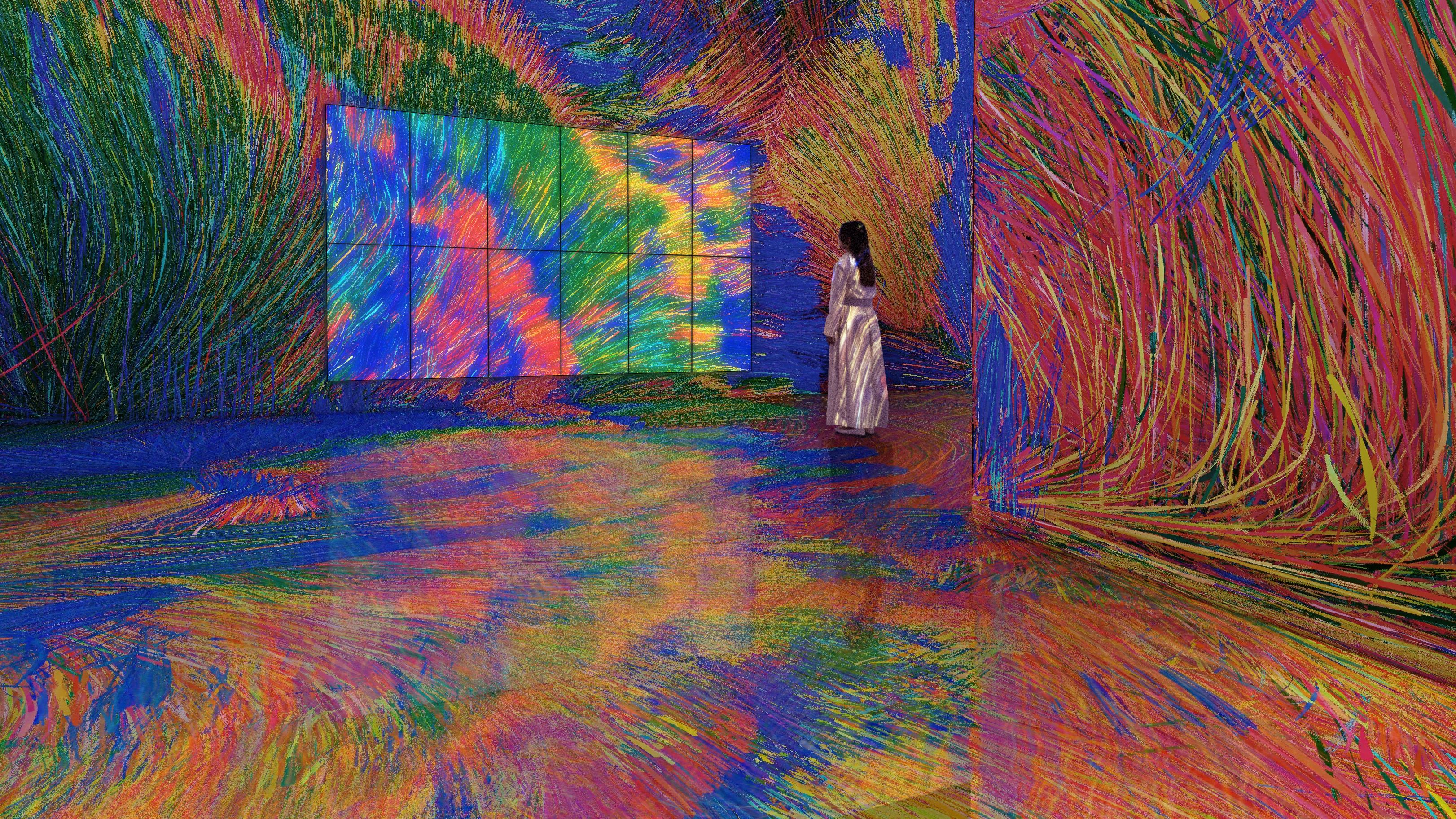
The strokes of color in this artwork do not have an overall focus; there is no guidance and no external influence. Through simple, localized interactions between the strokes themselves, and between the strokes and people, spontaneous order continuously emerges on its own, even as everything moves toward disorder.
Even if individual strokes are distant in space and time, when order is born, the individual elements transcend spatiotemporal discreteness and variability, appearing as a single entity. Despite significant changes in shape or size on the surface, or even if the elements are replaced, this spatiotemporal existence is maintained. Existence is not an accumulation of materials, but the order itself.
Existence is a part of the sea of disorder. It is eventually swallowed up by the disorder, and yet it continues to re-emerge. Order and disorder, existence and the whole, continuously flow into one another without boundaries, as they rise and fall, collide and merge.
This artwork is not an illusion that reveals a space on the other side of the screen. Within the actual space, the strokes continue to move across its surface. Walls and floors do not act as a boundary surface separating the viewer and the space of the artwork, but are the very places where the artwork space itself comes into existence.
The space of the artwork exists within the same coordinate system as the space where the viewer's bodies are. The viewer does not look at the screen from a single fixed point. Moving their body and shifting their viewpoint, they experience the interior of this spatiotemporal existence where order and disorder are born, collapse, and are born again.
This artwork is an attempt to expand painting from a completed image, or a perspective illusion of space, into a spatiotemporal pictorial space that is continuous with the real space, and that self-organizes from localized interactions.